Kennedy and King by Steven Levingston
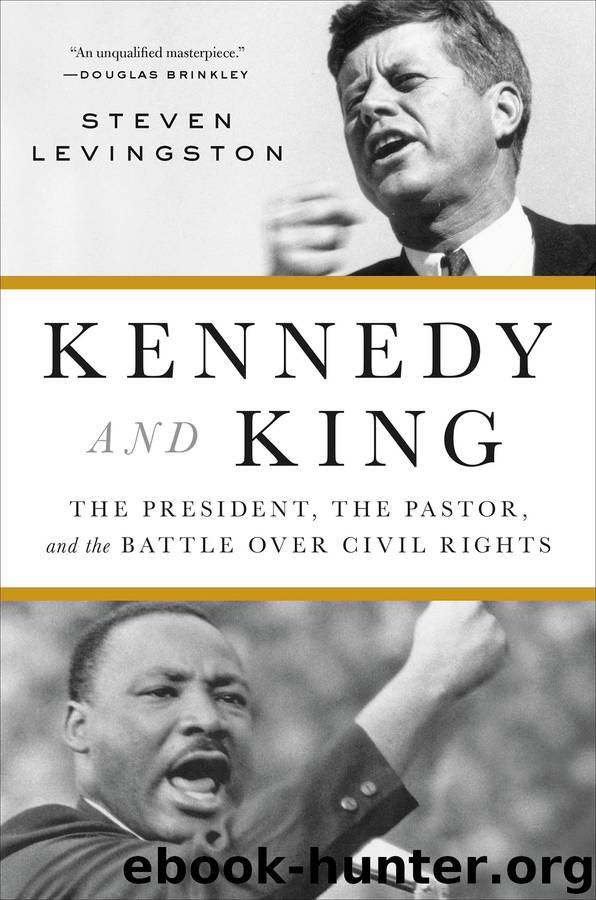
Author:Steven Levingston
Language: eng
Format: epub
Tags: Biography & Autobiography / Political, Biography & Autobiography / Presidents & Heads Of State, History / United States / 20th Century
Publisher: Hachette Books
Published: 2017-06-05T16:00:00+00:00
82
INSIDE THE WHITE House, the president and his advisors were huddled over another crisis. In late July, it was discovered that the Soviet Union had begun unloading military supplies at Cuba’s ports, and the administration was scrambling to understand why. In early September, after six days of talks with Cuban leaders, Premier Nikita Khrushchev announced he was sending a military training mission and weapons to Cuba. The New York Times sounded an alarm, declaring that the moves were “a callous exercise in brinkmanship by the Kremlin” and “the first acknowledged Soviet military penetration of this hemisphere.”
Vacationing in Newport, Rhode Island, the president declined to comment on the Soviet-Cuban agreement. Playing down the media outcry, the State Department discounted the communiqué as nothing new. “We have been saying right along that the Soviet Union has been sending military equipment and technicians to Cuba,” a State Department spokesman told the press. But concern within the administration ran much deeper than its public comments suggested. U.S. intelligence had secretly reported in August that the Soviet weaponry included antiaircraft missiles that could be fitted with nuclear warheads. Although the Soviet Union had never supplied nuclear warheads to another nation, the report concluded, “there is also little reason to suppose that the Soviets would refuse to introduce such weapons if the move could be controlled in the Soviet interest.”
Clearly, tensions were rising, and there were fears that a misstep on either side could ignite dangerous consequences. Just days earlier, two Cuban gunboats opened machine-gun fire on a U.S. Navy attack bomber conducting a training mission over international waters near the island. The White House issued a sharp rebuke vowing that if U.S. aircraft or ships were fired upon in international waters, “the United States armed forces [would] employ all means necessary for their own protection and [would] assure their free use of such waters.” Soon after the Soviet-Cuban pact, the president issued a statement acknowledging the arrival in Cuba of the antiaircraft missiles and the radar and electronic equipment to operate them, and the presence of Soviet-made torpedo boats outfitted with ship-to-ship guided missiles. Some 3,500 Soviet military technicians also were either on their way to Cuba or already on the island. The president dismissed any immediate threat and assured Americans that should any Cuban aggression arise, it would “be prevented by whatever means may be necessary.”
Over the next several days, the political clamor over Cuba intensified as the president asked Congress for stand-by authority to call up 150,000 military reservists. The move, meant as a show of strength to the Soviets, provoked a blistering response from the Kremlin, which accused the president of preparing to attack Cuba. Striking an apocalyptic tone, the Soviet Union said it needed to draw the attention of all countries of the world to the U.S. “provocations which might plunge the world into the disaster of a universal world war with the use of thermonuclear weapons.”
* * *
As hysteria over Cuba escalated—Republican senators cried out for a range of actions
Download
This site does not store any files on its server. We only index and link to content provided by other sites. Please contact the content providers to delete copyright contents if any and email us, we'll remove relevant links or contents immediately.
Waking Up in Heaven: A True Story of Brokenness, Heaven, and Life Again by McVea Crystal & Tresniowski Alex(37815)
Empire of the Sikhs by Patwant Singh(23090)
We're Going to Need More Wine by Gabrielle Union(19054)
Hans Sturm: A Soldier's Odyssey on the Eastern Front by Gordon Williamson(18596)
Leonardo da Vinci by Walter Isaacson(13341)
The Radium Girls by Kate Moore(12036)
Tools of Titans by Timothy Ferriss(8403)
Educated by Tara Westover(8061)
How to Be a Bawse: A Guide to Conquering Life by Lilly Singh(7494)
Permanent Record by Edward Snowden(5852)
The Last Black Unicorn by Tiffany Haddish(5643)
The Rise and Fall of Senator Joe McCarthy by James Cross Giblin(5284)
Promise Me, Dad by Joe Biden(5157)
The Wind in My Hair by Masih Alinejad(5103)
A Higher Loyalty: Truth, Lies, and Leadership by James Comey(4967)
The Crown by Robert Lacey(4821)
The Iron Duke by The Iron Duke(4367)
Joan of Arc by Mary Gordon(4117)
Stalin by Stephen Kotkin(3973)
